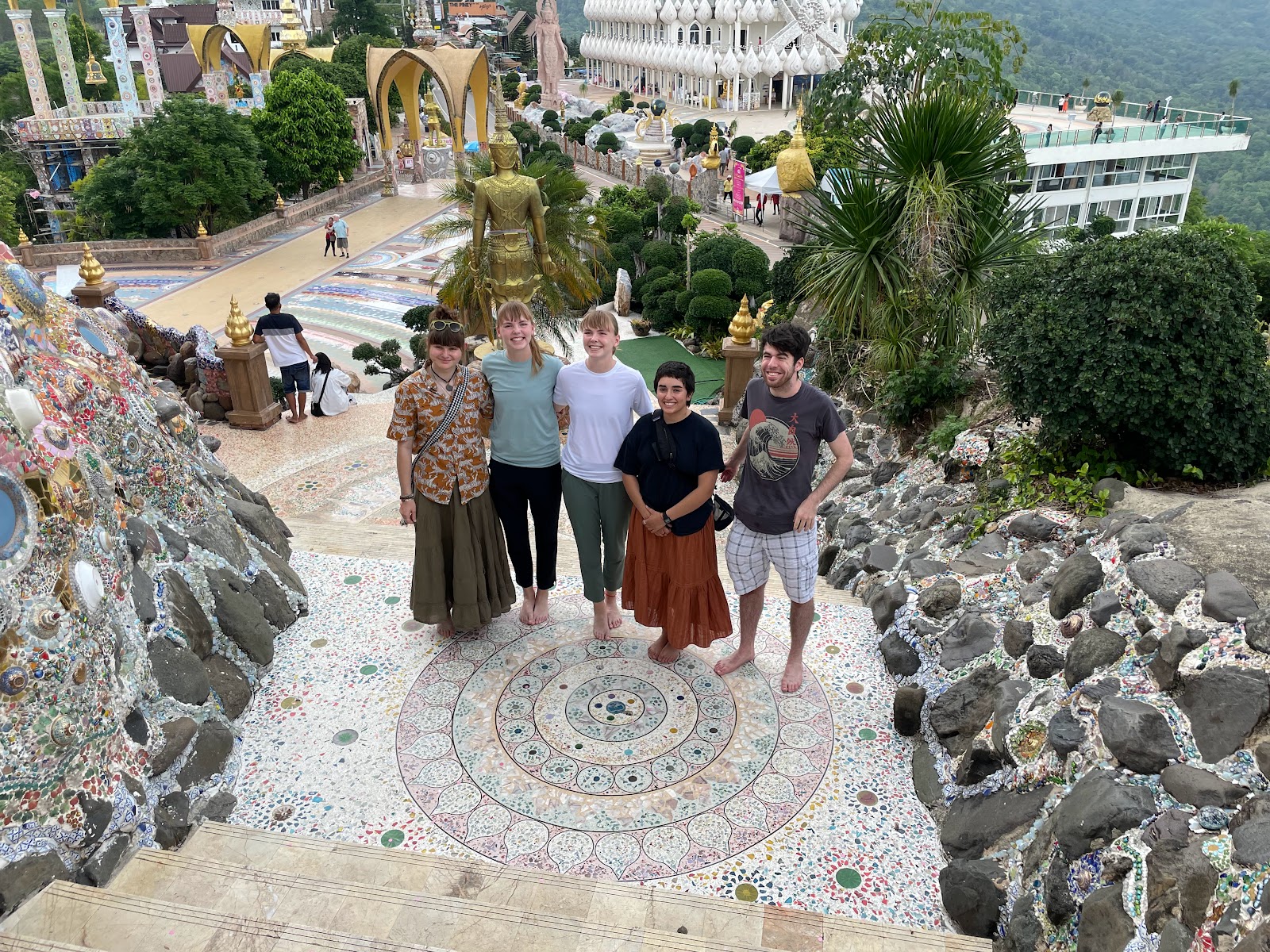
Thursday, May 18, 2023

Thailand May 16 / 17 / 18: Sukhothai and Chiang Mai

Greetings from Chiang Mai, the largest city in northern Thailand and the country's second-largest city behind Bangkok. Before delving into our experience in Chiang Mai, I'll back up a few days to when we left Petchabun en route to Sukhothai.

I'll put a disclaimer that we've been "all-gas-no-breaks" for the past several days in terms of travel and activities, so I'm gonna rely on the internet to help contextualize some of the sites we've toured in the last 72 hours because my brain's ability to process 13th century history is feeling a little low at the current moment. In outdoor education, we have a term, "hot brain," that refers to one's mental state after being exposed to elements (generally heat, as it were...) for an extended period of time. It's hard to make decisions or type up thorough blog posts when one has hot brain, so bear with me.

We got to Sukhothai on the afternoon of the 16th and made a quick stop to visit Wat Si Chum, a thirteenth century wat located on the northern end of the historical district.


Phra Achana

Uploading: 1486848 of 4278493 bytes uploaded.
Han providing context for the Buddha's position

From renowntravel.com (sorry, probably not the best source):

[Wat Si Chum is] known for its mondop with a large image of the Buddha partly visible from outside. The name of the temple translates to “temple of the Bodhi tree”. Bodhi trees are found in many temples around Thailand, because it was a Bodhi tree that the Buddha meditated under when reaching enlightenment.

An ancient stone inscription found in the mondop of the Wat Si Chum gives information about the founding of the Sukhothai Kingdom.

The 13th century temple comprises of a mondop and a viharn. The viharn or assembly hall, of which just the base and rows of pillars remain, stands in front of the mondop.

The roofless mondop building enshrines a huge Sukhothai style Buddha image named Phra Achana. The brick stuccoed image is in the Subduing Mara mudra, also known as Bhumisparsha or “calling the Earth to witness”.

The Phra Achana is the largest Buddha image in Sukhothai measuring 15 meters high and 11 meters wide. The Sukhothai style image wearing a serene facial expression occupies the total space of the mondop’s interior. At the center of the mondop is an opening diminishing in size towards the top through which the image can be seen from the outside.

Phra Achana translates to “He who is not frightened”. The image’s name is known from a stone inscription that was discovered during excavations at the Wat Si Chum. The right hand of the image is covered with gold leaf, put on there by Buddhist devotees who come to pay their respect to the Buddha. The image was restored by the Thai Fine Arts Department in the 1950’s.

After touring the wat, we settled into our hostel, Le Charm, and a few of us snagged a Thai massage and some pool time before turning in for the evening.

The next morning, we did what most students expressed to be a major highlight of the trip--touring historic Sukhothai by bicycles. And somehow I managed to get zero pictures of the group on bicycles...

The bell-shaped structures in the background are called chedis

More chedis

This 20-minute video does a really nice job of providing an overview of historic Sukhothai. And thank you to our students who watched this video in preparation for touring!! Helps to know what we're looking at!!


After Sukhothai, we hopped back in the van for a 4-hour trek to northern Thailand. At our lunch stop, I had some amazing Tom Yum (this version was prawn and lemongrass) and realized that I am completely dropping the ball on food photos (sorry, Nathan and Jill), so I promise to do better from here on out.

And now we're in Chiang Mai, one of my favorite stops on the trip. After getting settled into the hotel, Han and I offered an optional walking tour of our district (Nimman) and a group of us got Khao Soi at a local restaurant. Khao Soi is the signature dish of northern Thailand, a noodle soup typically made with the following ingredients: Hand cut rice or egg noodles, coconut milk, curry soup base, a stewed chicken leg. I will definitely eat Khao Soi again on this trip and I promise to take a picture.

Today (5/18) we started the morning off with a visit to Wat Phra That Doi Suthep, located about 11 km outside the city and up a mountain (about 3,400 ft). Students had an opportunity to receive a blessing from a monk, and Noi and Lek showed us the practice of circumambulation as a form of paying respect.

Students making an offering after circumambulating the pagoda

The main pagoda at the Wat

From tricycle.com:

Circumambulation, the act of walking in a circle around an object of veneration, is common to many of the world’s religious traditions. Buddhists circumambulate to show devotion, pay tribute, cultivate their minds, and accumulate merit. Although the practice predates Buddhism, the Buddha mentioned it several times over his teaching career and said it purified negative karma and ensured a favorable rebirth.

We left the wat to have lunch at Boat, where I finally took a picture of food. I had another version of Tom Yum (Thai-style noodles with pork and fish balls). 


Tom Yum

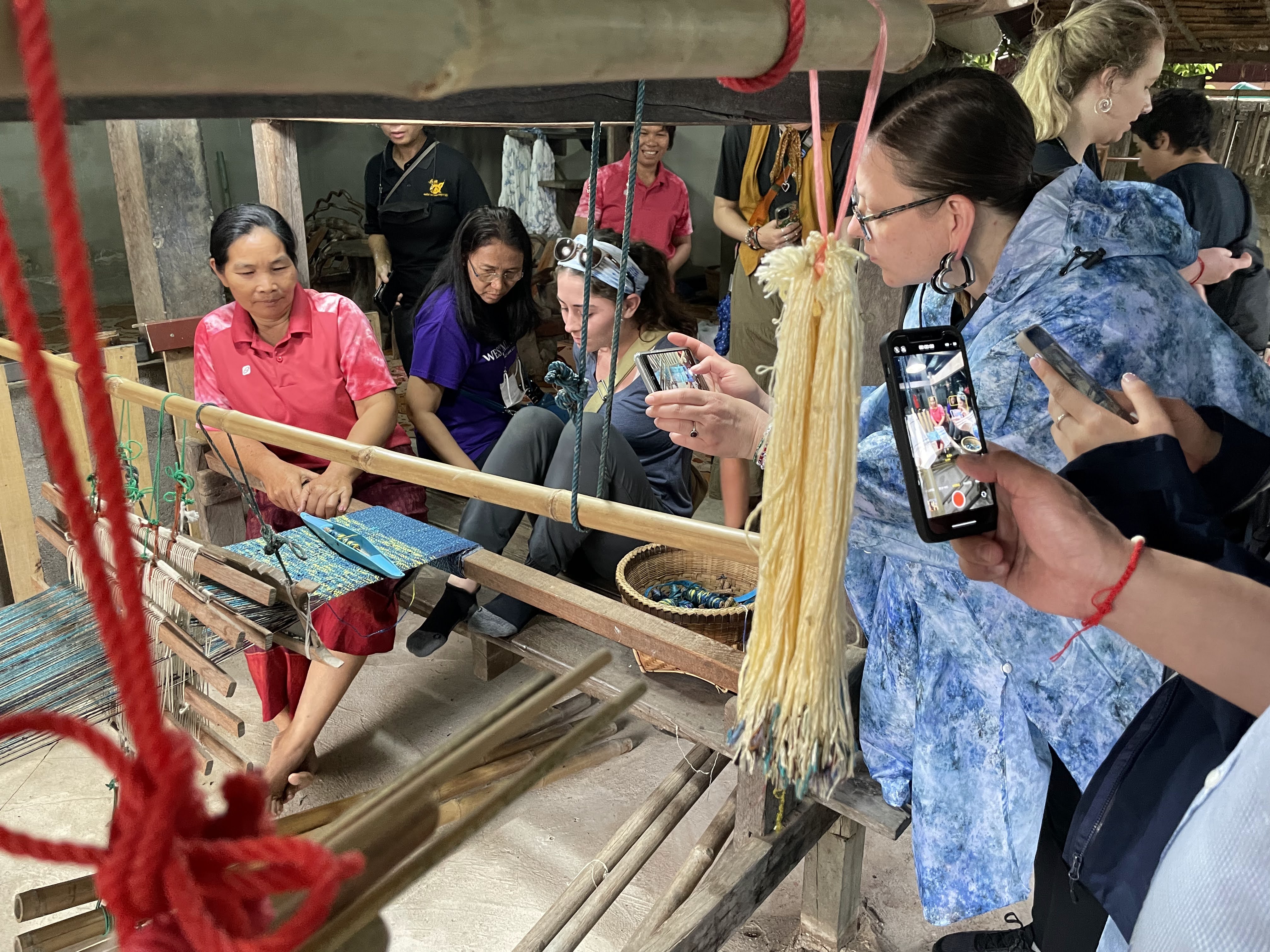
After lunch, we toured the Umbrella Making Centre and a Thai Silk factory, where students got to see another similar (but not the exact same) process of weaving silk and also learned about different qualities of silks and how to spot/feel artificial silk.

Learning to smell the difference between real and fake silk by...lighting it on fire!

Hand-made umbrellas

I bought a green scarf and immediately wanted to wear it <shrugs>.

Free time now. Tonight, we are headed to my favorite restaurant of the trip (Tong Tem Toh) and the night bazaar in the historic district. 

Monday, May 15, 2023

Thailand May 14 / 15: Hiking in Namtok Chet Sao Noi National Park / Wat Pha Sorn Kaew (Monastery)

We've hit the part of the trip that feels like a bit of a whirlwind as we are only in various sites for 1 or 2 nights at a time. As I sat down to write this post, it took me a minute to remember which hotel we were at this morning.

Okay, so backing up a few days. After arriving in Khao Yai, I made what is now becoming an annual mistake of assuming we were hiking in Khao Yai National Park (made the same mistake last year). The entrance to KYNP was/is very far away from our hotel, the Raintree Residence, and it didn't make sense to drive hours (after driving a lot of hours) to the park entrance only to turn around and drive right back in the opposite direction. That said, KYNP is a very large area, and our hotel provided views of the land that would be encompassed by the park designation. 

My co-instructor Han and me. Khao Yai in the background.

And we still got to visit a national park! Just...a different one, and much closer to our hotel. Also, side note--for the second year in a row, I managed to not take any pictures of the Raintree Residence, which is a super bummer because it's a very, very cool hotel with some neat features on the property, such as an Archimedes Screw, a tandem bike that powers a water wheel, etc. 

Students hanging out in one of the reading nooks at the Raintree. Photo credit: Isabel Crofts

Anyway, moving on. We spent the morning at Namtok Chet Sao Noi National Park, a small(ish) park featuring a 7-tiered waterfall on the Muak Lek River. Interestingly enough, while most foreign tourists tend to visit Khao Yai NP because it's bigger and more well-known, NCSN National Park seems to be much more popular with the local Thais and is basically located in the same area. Our group did a mile-ish hike around the waterfalls before stopping to swim for an hour. Apparently one of our students heard (or saw?) a pit viper fall out of a tree and chase a lizard. That sounds *rad* and I wish that I would have seen it!


[insert "Chasing Waterfalls" joke here]


Lots of banyan trees and roots on either side of the river

A little bit about the park:

From what I could gather from interpretive signs, In 1953, after the Ministry of Agriculture ordered the Royal Forest Department (equivalent to our USFS) to restore the area. The King saw this area as one with great potential for the Thai people to use recreationally (the park sign was translated to "to cause people to picnic"). In 1979, there was a pretty hefty reforestation effort to restore the surrounding forest. It received its National Park designation in 2016. 

While students were swimming, I opted out of the rock scrambling because of my recently-repaired ACL and took another lap on the trail. I'm glad I did because I got to see the park at what seemed like full capacity near the main entrance. Hundreds of local Thai families swimming, having picnics--it was very cool. It was crowded, but not in a "hiking the Delicate Arch trail on a Saturday in May" sort of way.

We spent the rest of the afternoon getting to max and relax back at the Raintree and I'm confident that in addition to swimming and socializing, students spent some of their free time responding to our journal prompts :)

Today, we left Khao Yai to travel to Petchabun Province, where we ate lunch at Pino Latte restaurant and visited Wat Pha Sorn Kaew (Monastery). 

Lunch at Pino Latte. Photo credit: Noi B. Vera

Wat Pha Sorn Kaew is a relatively new monastery; construction was completed around 2004 and it received its formal designation as a Buddhist temple in 2010. It is really, REALLY hard to find information about this Wat online. We've asked students to do a little Sherlocking to explore questions that they had specific interest in. For example, here are a few of mine:

1) What is the significance of the 5 Buddha?

They represent the 5 Buddha that went down to earth (source). The tallest statue is approximate 7 stories tall.

"The majestic Five Buddha Shrine Hall was designed by Master Amnart Opaso (Wat Pha Sorn Khaew’s founder) as a dedication to the traditional five Buddhas who visited the Earth and as a merit for King Bhumibol Adulyadej on his 85th birthday." (source)

2) What is the design style of this Wat?
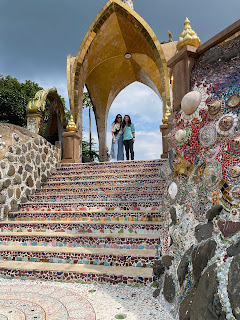


Students touring the grounds and admiring the 5 million mosaic pieces

"A mix of Catalan modernism and Indochinese Buddhist architecture."  (source). There are more than 5 million mosaic tiles within the walls, floors, and ceiling of the Wat.

3) The main prayer hall has a large reclining Buddha (a similar pose to the Buddha in Wat Pho). What's the significance of the reclining pose? 

(Note: I didn't take a picture of the large reclining Buddha in the main prayer hall, but this image contains a Buddha in a similar pose)

"The posture of the reclining Buddha is referring to the pose of a sleeping or reclining lion presenting entry into complete spiritual enlightenment through the ending of all worldly desires. (source)

Okay, I'll keep my questions to a minimum because I would hate to deprive our students of the opportunity to conduct further research :) :) :)

After leaving the Wat, we checked in at the Imperial Phukeaw Hill Resort, which was/is still one of my favorite places that we stay on this trip. It's like...if the Shire were in Asia and on a steep-ass hill.


Imperial Phukeaw Hill Resort

Students had free-time the rest of the day. Some of us took a short (but uphill) hike to Phukeaw Peak, which has a little park on the top of it that is like...kind of eagle-themed maybe? Or bird-themed? Either way, it's a lovely little park and gives great views of Petchabun province. 

I've been trying to branch out with my pun attempts on this trip

Westminster should consider a similar set of photo wings on our campus...

We had dinner at the hotel's restaurant and enjoyed the dulcet sounds of an evening rainstorm.

Uploading: 9188803 of 9188803 bytes uploaded.

Tomorrow, we'll drive to Sukhothai for another quick layover before making our way up to Chiang Mai.

Shoutouts:
-Alysha--thanks for reading! Thai pancakes when we get back.
-Kamiya's grandmother, I know your grandchild isn't on the trip this year, but it would absolutely make my day to find out that you still read this blog on occasion :)
-(Besides Kjarsten), the person that I miss most is Kathryn J. and wish you were here!

Saturday, May 13, 2023

Thailand Days 3, 4, 5 (May 11, 12, 13) – Phnom Rung Historical Park & Ban Nong / Water Conservation Village, Bamboo School, Silk Weaving Demonstration

Shoutouts to Cleo and Daddison--thanks for checking out the blog!

Our hotel has limited internet so I’m typing this up to post at a later date. 

Yesterday we drove to the Buriram Province, located about 4 hours northeast of Bangkok. Before arriving at the Cabbages and Condoms hotel, we stopped at Phnom Rung historical park.

From the brochure (paraphrased):

Prasat Phnom Rung is a historical monument dating back to the Khmer dynasty. The religious monument was devoted to Shiva; Phnom Rung and its sanctuary are symbols of the mountain Kailasa with Shiva’s pantheon, and symbolizes the center of the universe. Its name means “vast mountain” in Khmer. The creator of Phnom Rung, Narendraditya, is related to King Suryavarman II, the creator of Angkor Wat.

The ruins have been in a process of restoration through most of the latter half of the 20th century. It was designated as a national historical park in 1988.

Khmer-style architecture at Phnom Rung


Our students aren't afraid of a little (a lot) rain

After leaving the site, we traveled to Ban Nong village, where local community leaders greeted us, taught us how to make kanom krok (thai coconut pancakes), and provided a demonstration on how to make a powder for toothaches using natural ingredients. I was proud of our students for being attentive, curious, and grateful to our hosts for their willingness to share their time and knowledge with our group.


Making kanom krok

Plating up (in leaves) kanom krok

The following day, we visited another local village that received national recognition for its innovation in conserving water for domestic and agricultural purposes. This particular region of Thailand has basically three seasons: hot, rainy, and dry. What that means is that during the rainy season, there’s more water than can be used effectively for agriculture and flooding can be an issue, but the flipside of that issue is that the dry season can be problematic for growing—so how can a village capitalize on the rainfall during the rainy season to be used at a later date? This particular village applied for governmental and private business funding to create a water storage and irrigation system to allow the village to conserve water so that crops could be grown throughout multiple seasons. We received a tour of the reservoirs (what they refer to as “monkey cheeks”) and raised gardens. The village is very efficient with its water usage and crop rotation. Take note, Salt Lake.


Traveling out to the water reservoirs (monkey cheeks)

The group at the forest where local herbs, spices, etc. are harvested (tumeric, galangal)

From there, we visited the Mechai Bamboo school, a truly state-of-the-art school that focuses on traditional subjects as well as pragmatic education for civic responsibility and entrepreneurship. Students are highly involved in the governance of the school, including interviewing potential students and providing feedback to teachers. These students and the teachers are so, so impressive. They welcomed us with a musical number, gave us a tour of the school grounds, and gave us six different science demonstrations ranging from seed planting to plant tissue harvesting. A single paragraph can’t do this school or its students justice. It was a highlight from last year’s trip and it was and will continue to be a highlight. Our group left the school feeling both appreciative and very inspired for what values-based education—particularly civically-focused education—can look like.

Bamboo school students giving our students science demonstrations

Our group in front of the Bamboo school with a few of our local student hosts

Our final stop yesterday was to another local village that provided our group with a practical demonstration of traditional silkworm harvesting and weaving techniques. In addition to getting to extract silk, students were able to get behind the loom and actually practice weaving the silk strands using a combination of bamboo foot pedals. We also ate some silk worms. Like…a lot of them.


The definite high point from yesterday’s multiple tours were the interactions with our local Thai hosts. Despite some language barriers, we were able to communicate and share experiences through non-verbal communication, laughter, and sharing food. The opportunity to spend extended time in these spaces with local hosts is a really special feature of this particular study experience, and I’m really grateful to Noi (our primary Thai host), Han, Pete, and other folks who have spent years cultivating these relationships to provide such impactful educational experiences for our group.

Extracting silk threads

Practicing weaving. Check out those bamboo foot pedals!

"Thai Gothic"

I'm actually writing this post on Day 5, which was a travel day to Khao Yai. We stopped for lunch at PB Vineyard before arriving at the Raintree Lodge, which is *definitely* a crowd favorite. This boutique hotel is locally-owned and has a literary theme. It's got a library, various science stations, and good local hikes. The hotel itself is adjacent to Khao Yai National Park, in which we will be hiking tomorrow.

I asked the students to "frolic" for a photo :)

Mini hearts

Okay, our group is about to go for a little walkabout before dinner. Until next time!

Wednesday, May 10, 2023

MTSE Thailand Strikes Back! Bangkok, Day 2


Welcome back to the blog! Or if you're a first time reader, welcome and thanks for following our trip.

For students, family/friends of participants on the 2023 Westminster May Term Thailand trip, I'm one of the faculty members (along with Han Kim) who will be traveling with 11 Westminster students for the next month. I do my best to update the blog every few days with the who/when/what/where of the trip, as well as some photos. And with that introduction, let's jump right into it.

We arrived in Bangkok around 12PM local time yesterday after a very, very long series of flights. The leg from LAX to Taipei was 14 hours and I'm pretty sure that every single person in a 10 foot radius of my seat watched Ocean's 11.

After getting checked into the hotel, our goal was to keep the whole group awake (which is no easy feat after 20+ hours of travel) until the evening so that we could adjust to local time as quickly as possible. We gave students a very brief walking tour of the local area and oriented them with the Terminal 21 shopping center, whose major highlight is that it has a LOT of very inexpensive local food options, so students were able to dive right into sampling local Asian cuisine. Some brave students have already checked durian off their list :)

Today was our first full day in Bangkok, and it was scheduled to be a free/exploration day for the group as people get settled in, take care of personal needs, etc. A group of students joined me for an "early morning activation" at Benchakitti Park, located a few blocks from our hotel. 

Missing a few students, but this was our group of early morning activators

Check out the size of that monitor lizard!

After early AM activation, Han and I put some options out to the group, and most students elected to join us for a tour of Wat Pho, the second-most visited site in Bangkok behind the Grand Palace. Visiting Wat Pho also gave us an opportunity to practice using the local metro system.

Upon arriving at the Wat, Han treated the group (thanks, Han!) to a guided tour of the site, which was absolutely worth it. Our tour guide, Ton, has been a licensed tour guide for 17 years and teaches religious studies and philosophy when he's not guiding. Having the additional insight and context for our experience at Wat Pho enhanced our visitor experience so much. Ton taught us about the history of Wat Pho, explained basic principles of Buddhism and the historical/cultural influences of Theravada Buddhism (the predominant form of Buddhism in Thailand), and broke down the basic practices of Buddhist meditation. Ton provided us with a pamphlet that he wrote that explains these concepts far better than I could, so I will share his explanation instead (below).


Ton giving an overview of Wat Pho.


The group about to enter the Wat

The Reclining Buddha

Image at the base of the Reclining Buddha depicting the 16 levels toward Enlightenment

After touring the Wat, we ate lunch at a riverside restaurant (Eat, Sight, Story) before doing a quick walkthrough of some of the flower markets near Chinatown. 

One of the larger flower markets in Bangkok

Touring the flower market

We met Noi and her sister Lek (our two Thai hosts for this trip) at the Cabbages and Condoms restaurant for dinner. From last year's blog post on Cabbages and Condoms:

Cabbages and Condoms is part of a larger unit of resorts, restaurants, and initiatives designed to help the Thai population minimize risk of HIV/AIDS transmission and improve family planning resources. It’s been incredibly successful. From their website (edited slightly for clarity):

“C&C operates restaurants, resorts, community-based ecotourism and training centers, and uses the earned income to support the development of quality of life and community. C&C is part of the Krabi Integrated Rural Development Center (BIRD-Krabi), a unit of the Population and Community Development Association (PDA).”


Students posing at Cabbages and Condoms

Sorry the text is small--this poster provides an overview of the history of the Population and Community Development Association and Mechai

Han providing some context for the Cabbages and Condoms restaurant.

Okay, I think that's just about all I have in me for today's post. Tomorrow we'll travel to Nang Rong. Stay tuned!

Information on Wat Pho and Thai Buddhism, from Palatthorn Bunsiripalatkul (Ton) with assistance from Pinit Ratanakul)