Saturday, May 14, 2022

Thailand Day 6: Thong Somboon Club / Muak Lek Arboretum & Waterfall

After a lovely pre-breakfast jog/walk with students and Kathryn/Han, we drove an hour northeast to Thong Somboom Club, which is a theme park of sorts. But not just any theme park. A "Western-Themed" theme park.


Repping SLC Beehive Sport and Social Club (and specifically, Ref Jimmy's face) abroad on our run this morning.

I'm not sure if members of our group have visited theme parks in other counties (I have not), but this wasn't like going to Disneyland Paris or Tokyo in terms of being a park that caters to international tourists. This park is definitely a tourist destination for Thais, and it was fascinating to get a glimpse of how the people of Thailand (and many other counties) perceive U.S. American culture, and specifically, "Cowboys and Indians."


Students in front of some "Western" shops at the theme park.

Before going any further, I will pause to acknowledge that "Cowboys and Indians" as both a term and a concept are problematic, and that the "Wild West" motif is fraught with cultural appropriation and a lack of cultural sensitivity with regard to Indigenous Nations. And the fact that other countries have latched onto this cultural phenomenon is 100% our fault! We (the U.S.) marketed the crap out of the American Old West as early as the late 19th century, and Thailand is just one of several countries who have embraced the myths of the American Old West in the form of a theme park. If you want to know more, check out this article published in Indian Country Today (Red Haircrow, 2018) about Germany's obsession with Indian culture. And before I/we (the U.S.) point too many fingers at other countries for misrepresenting and mis-appropriating Indigenous cultures, I'd kindly remind us to take a look around at U.S. high school and college football games, as our country still has about 2,000 schools (my alma mater being one of them...) that use Native American mascots.

The point being that going to this theme park was a pretty significant eye opener for our group. While racing go-carts and hurling down rainbow road luges was absolutely fun, being in the park really encouraged our group to consider international perspectives on "American" imagery and culture. Furthermore, as the park is a domestic tourist attraction, as opposed to an international tourist attraction, I think many members of our group--myself included--had some "fish out of water" moments that also led to valuable conversations. Other visitors constantly snapped pictures of members of our group, we misunderstood directions, and we definitely drove our ATVs, go-carts, and side-by-side buggies waaaaay faster than anyone else in the park.

Kathryn and I getting ready to rip it on some ATVs

Students driving the buggy around the dirt track

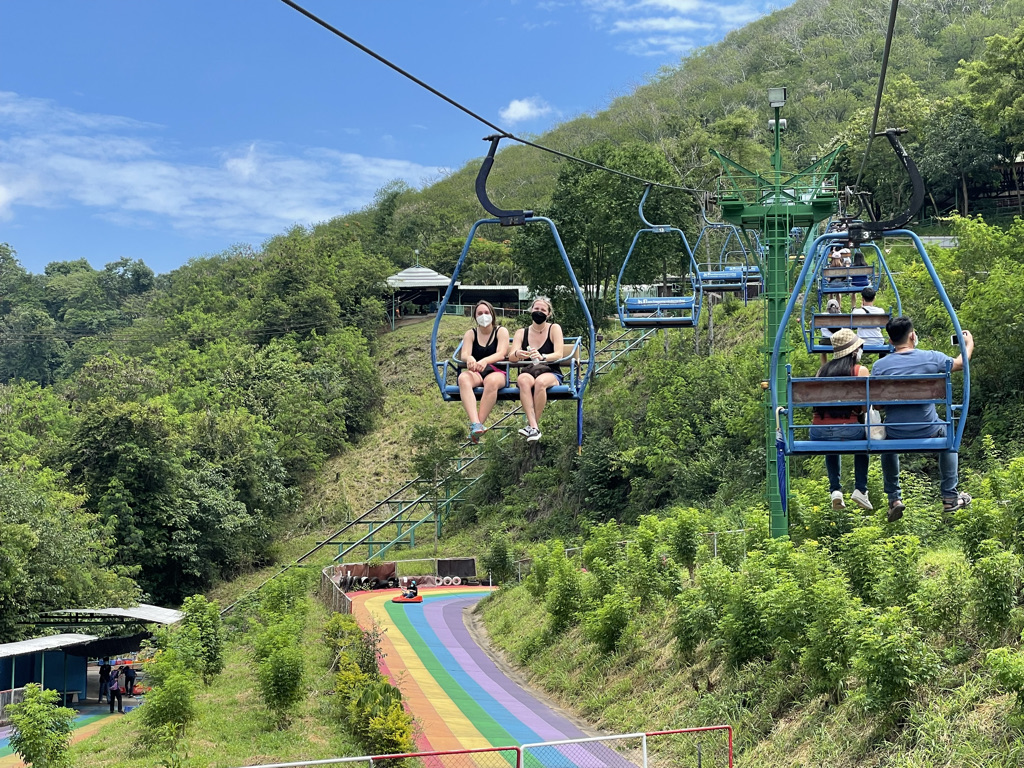
Students on the sky chairs. The rainbow road luge (my favorite) is below.

We ate lunch at the park (American hamburgers and french fries!) and started making our way back to the Raintree Residence. On the way, we made a short stop to Muak Lek Arboretum and Waterfall. Of all the places we've visited thus far, this one actually felt the most relatable to a Utah recreation experience. It was a beautiful area with a river and waterfall, and it was CROWDED. The Arboretum is clearly a popular local destination for hiking, picnics, wading, etc., and it was interesting to experience and perceive what local Thai folks might do on a typical weekend afternoon if they want to get outside. And same issues that we experience in Utah re: overcrowding.

The group in front of the entrance to Muak Lek Arboretum

Don't let my expertly-framed picture fool you. There were gobs of people here.


After the waterfall, we had a few hours of free time before returning to PB Winery for another nice dinner.


Chicken lemongrass dinner at PB Winery

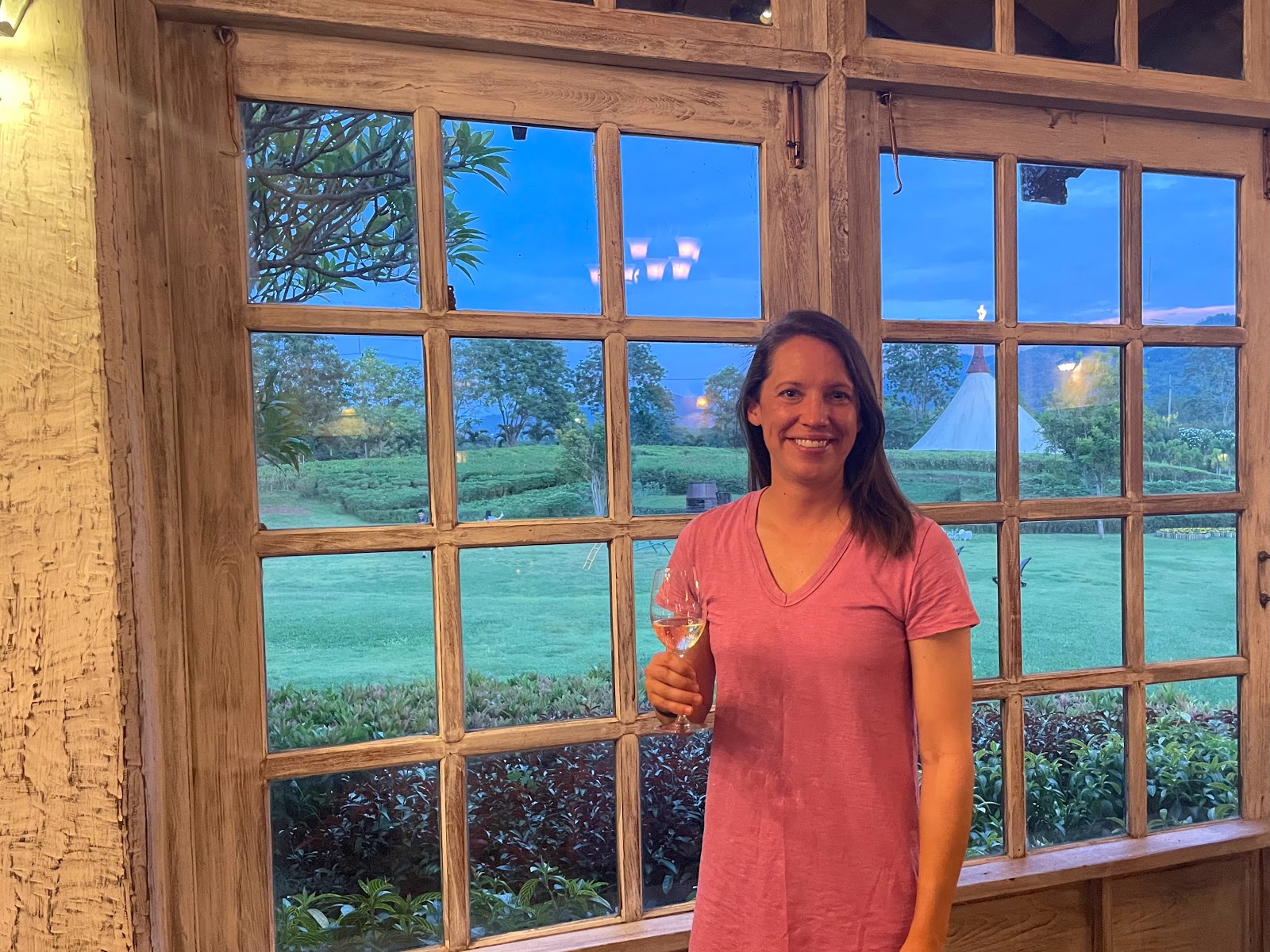
Enjoying the sunset at PB Winery

Tomorrow, we head to Phetchabun. 

Friday, May 13, 2022

Thailand Day 5: Khao Yai

I'm writing this post while enjoying the dulcet sounds of a tropical rainstorm from the balcony of my hotel room. We had thunder and lightening earlier in the evening, which was a real treat for us Utahns. Do I get to consider myself a Utahn after a 5-year residency?

We left Buriram Province this morning en route to Khao Yai, which is in the Nakhon Ratchasima Province. For the next few days, our trip is shifting focus from "Education [from a Global Citizen Perspective]" to "Responsible Tourism [from a Global Citizen Perspective]."

Outdoor Education and Leadership is a new focus for this study abroad experience. When planning the trip, Han, Kathryn, and I wanted to figure out how best to incorporate OEL concepts and themes into our learning goals without making it all about "doing outdoor activities" (e.g. mountain biking) and ignoring critical cultural, historic, and geographical contexts. We decided that exploring notions of "responsible tourism" would provide opportunities for our group to explore recreation, ecotourism, economic impacts of recreation/tourism, etc. while still honoring the central theme of global citizenship.

That being said, today's experiences in tourism are a pretty stark contrast to our tourist experiences in the rural villages yesterday. Our primary activity today was a tour of the PB Valley Winery (link). 

Established by Dr. Piya Bhirombhakdi, PB Winery represents the culmination of the founder's dream to "create affordable Thai wine to the eyes of the world." From their website: 

One of the very first large scale and high professional wineries in the tropical country was established since 1989. The vineyard settles beautifully on a valley over 2,500 rais (400 hectares / 1,000 acres), 350 to 380 maters above the sea level, guaranteeing a well-condition climate. The winery is spread out over 3,000 square mater, including a Barrique room housing genuine oak barrels made in France, each holding 255 liters. A total of 150,000 liters of wine, or the equivalent yields of 200,000 bottles, are natured there to mature every year. (link)

We were treated to a nice lunch at the vineyard followed by a tour of the grounds and winemaking facilities. Throughout the tour, our guides explained the process of harvesting grapes and winemaking. Students seemed to enjoy the experience, but in our van ride home, they were quick to point out the differences they felt as tourists between being in a rural community learning directly from the members of the community (e.g. the silk weavers) versus the experience of touring a winery whose impact on the community felt further removed. In both cases, the central question for most students was "who benefits from tourism?"

View of the vineyard grounds

View of the grounds

Daily "Kelfie" at the winery

Students enjoying lunch at PB Winery

What's a vineyard tour without grapes?

Wine aging in barrels

Our lodging for the next two evenings, the Raintree Residence in Khao Yai, is one of the most unique resorts I've had an opportunity to stay at. Founded by Suwadee and Phijit Chongsatitwatana, former book publishers and book enthusiasts, the Raintree Residence celebrates literature in every room of the hotel. Each hotel room has a specific literary theme. The hotel grounds offer hiking trails, unique sitting areas for reading and reflection, a library, several pools, and various sites for science demonstrations (e.g. a bike-powered waterwheel--guests can pedal the bike to turn the wheel). Learn more about the resort here (link). It's funky and eclectic and a little swanky. 

The Raintree Residence lobby

One of the many sitting/reading nooks at the Raintree Residence

One of two pools on-site

We got to the resort relatively early in the afternoon, so students had several hours to explore the grounds, swim in one of two infinity pools, nap in a hammock, etc. The hotel staff set up a lovely poolside dinner for us, and we closed out the evening as a large group sitting on the ground under a covered roof listening to the rain.

View of Khao Yai landscape from our afternoon hike

Students and Han enjoying the grounds

MTSE Faculty sitting on a swing during our free afternoon

Tomorrow is going to be...interesting. We are going to a Western-themed amusement and/or eco-park. Stay tuned.

Thursday, May 12, 2022

Thailand Day 4: Buriram Province

Today was a very full day.

We left Cabbages and Condoms around 8AM with the goal of visiting several local rural villages who are in partnership with the Population and Community Development Association (PDA) that I mentioned in the last post.

Our first stop was Wat Ban Khok Phluang (I think that’s the name of the town?). In this village, we learned about how the PDA partnered with the community to build water retention and irrigation systems to help preserve water collected during the rainy season (approximately April -June) to irrigate crops / serve houses during the dry season. Thailand is a country of extremes—while it has seemed to be perpetually rainy and humid since our arrival, we are at the very beginning of rainy season. Certain parts of the country, including the Buri Ram province, go through extreme periods of dryness/drought, so it’s important for local communities to find ways to maintain a water supply.

Students learning about the water conservation and irrigation process

In addition to helping build the water collection/irrigation system, the PDA worked with locals to teach them farming techniques so they could use their new skills—coupled with micro-finance loans—to develop their own agricultural businesses (selling crops to other local communities). Based on our observations and conversations with the community, the initiative seems to have been very successful. I think I remember hearing that their primary crops are tapioca and rice? Don’t quote me on that.

Example of water conservation / irrigation project

Stop two was another local village and for the life of me I cannot figure out its name. I *think* it would have been somewhere along the road connecting Wat Ban Khok Phluang to the Mechai Bamboo School. I think.

Whoa. Time out during the post so this could happen:

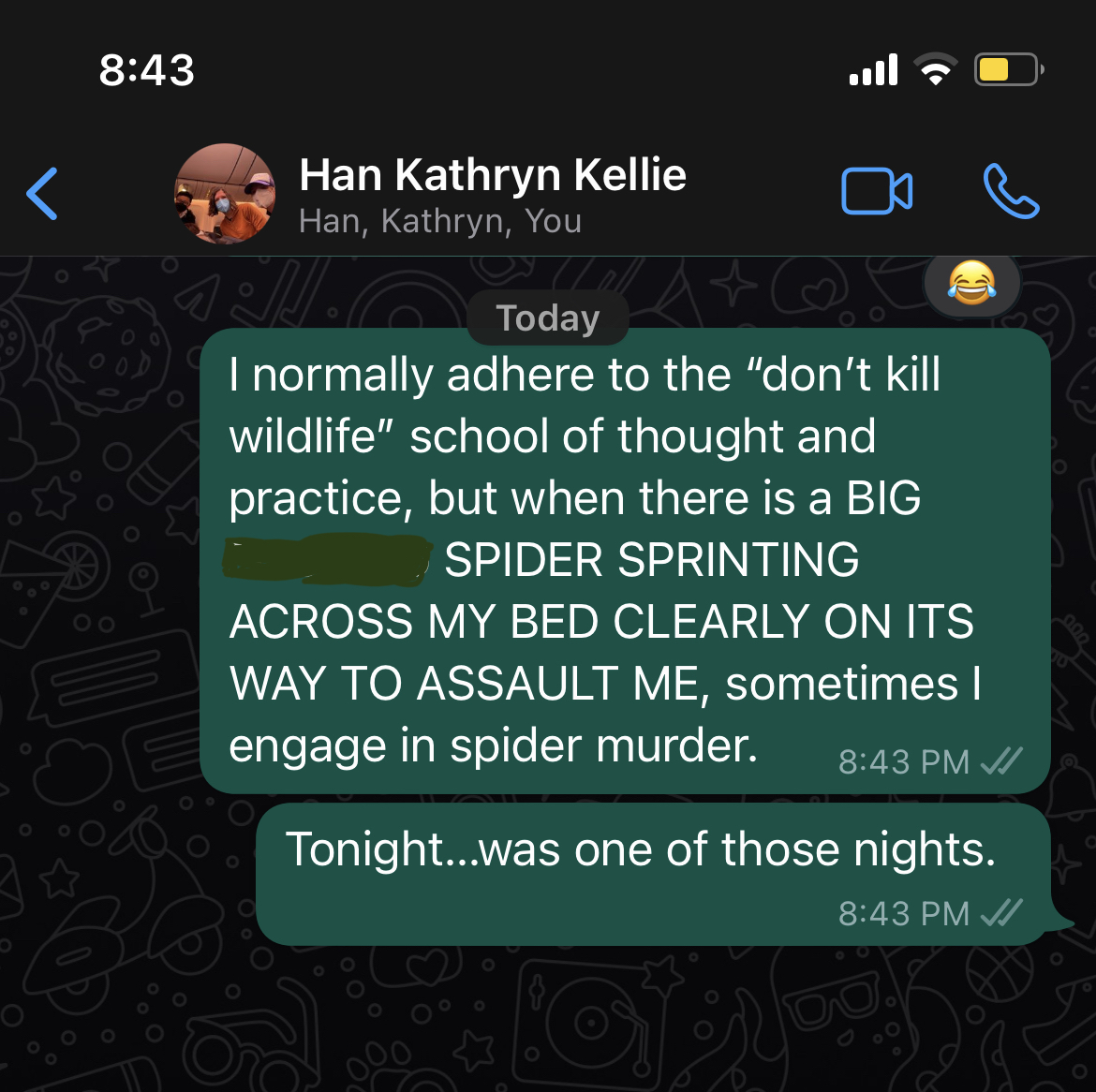
Screenshot of a conversation with Kathryn about the attack spider

And to be clear, this resort is super clean and awesome, but we are in the middle of a subtropical forest region and there are just a bazillion critters. There’s currently a little gecko scrambling about my room right now, and I’m glad it’s here because it will eat the other spiders who have plans to attack me in my sleep. Also, geckos are super loud. Who knew?

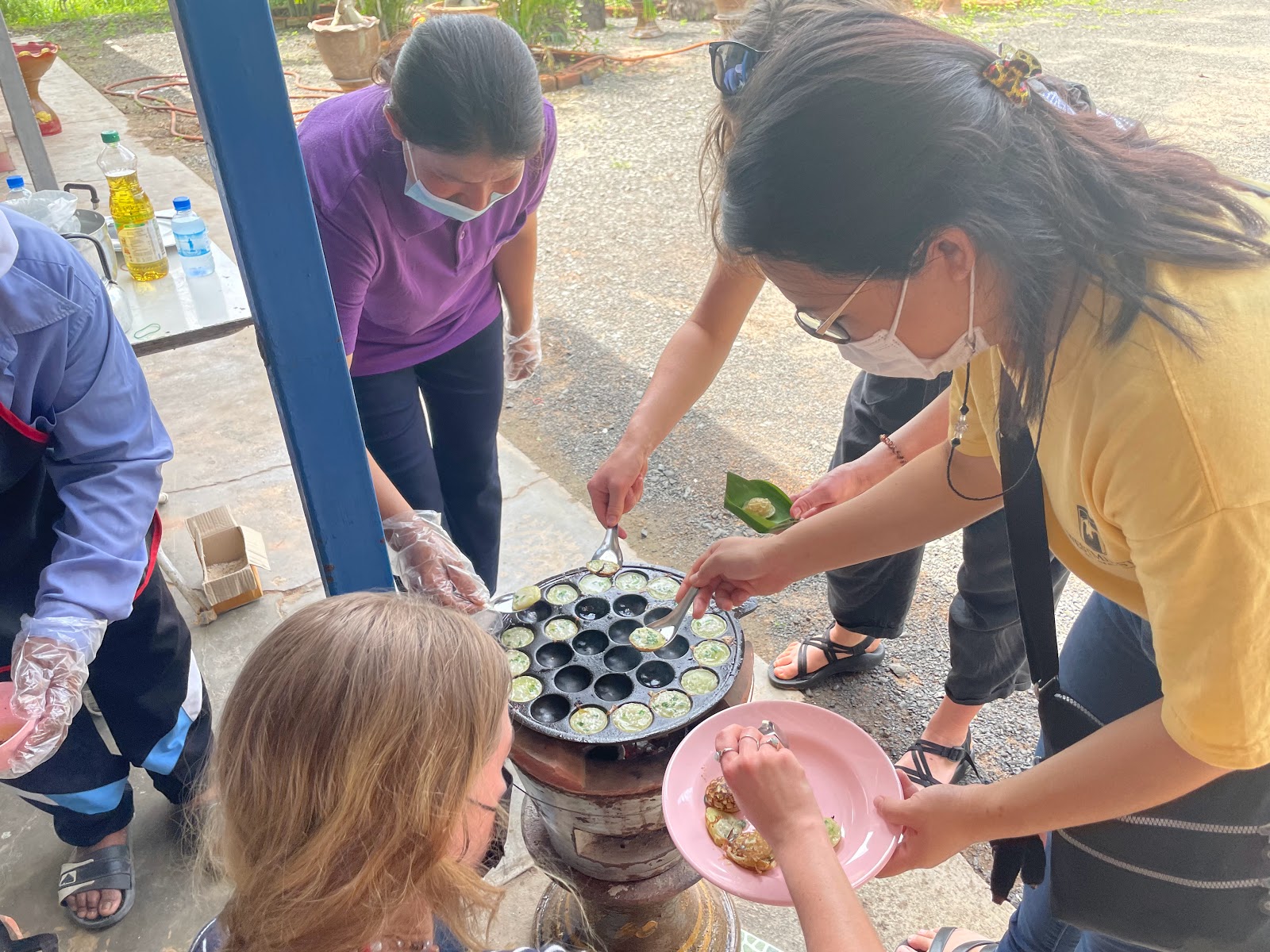
But I digress. The second village explained that they produce honey and items for natural remedies and body care. Representatives hosted a demonstration in which they created the base for toothpaste using natural ingredients. The menthol smelled amazing. The villagers also fed us these super tasty coconut/rice flour pancakes (kanom krok) and fresh coconut water. Yum!

Students learning about the kanom krok process

The finished product (kanom krock)

Students learning how to make toothpaste from natural ingredients

Stop 3 was the highlight of the day for most folks: the Mechai Bamboo School. It’ll be impossible to describe how incredible this school and its students are in a blog post. The mission of the school is to have “a cheerful revolution in rural education.” Students pay no tuition; instead, the students and their parents complete 800 hours of community service and plant 800 trees a year. Students are heavily involved in school governance and engage in their surrounding communities. I would strongly encourage my readers (and my readers, I mean my mom ) to watch this short video to get a better sense of what the Mechai School is and what makes it special.

When we arrived at the school, we all got a surprise COVID test (!). Luckily, we all tested negative. The students and a few faculty gave us a tour of the school grounds, and then we were treated to a delicious lunch with produce grown on-site at the school, a musical demonstration, and several science demonstrations to explain tissue sampling and how their hydroponic growing system works. One of my favorite parts of this experience was watching our Westminster students develop connections with the Mechai students. By the end of the afternoon, they were swapping Instagram handles.

Everything is colorful at the Mechai School

Getting ready to enter the bamboo dome/take a surprise COVID test


The Mechai School's hydroponic growing system in action

Close-up shot of the bamboo used as irrigation pipes

Students at the Mechai School performing a musical demonstration

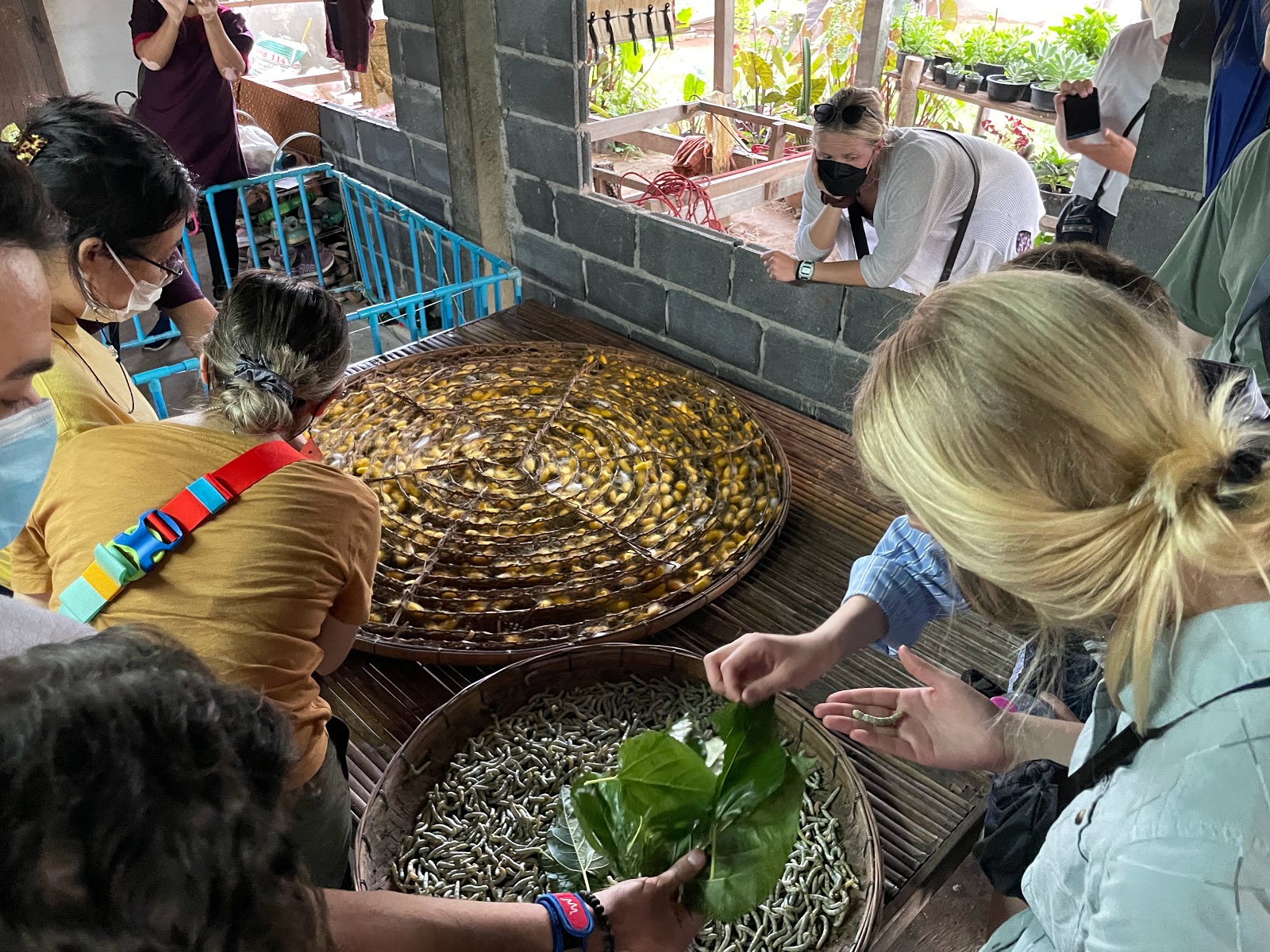
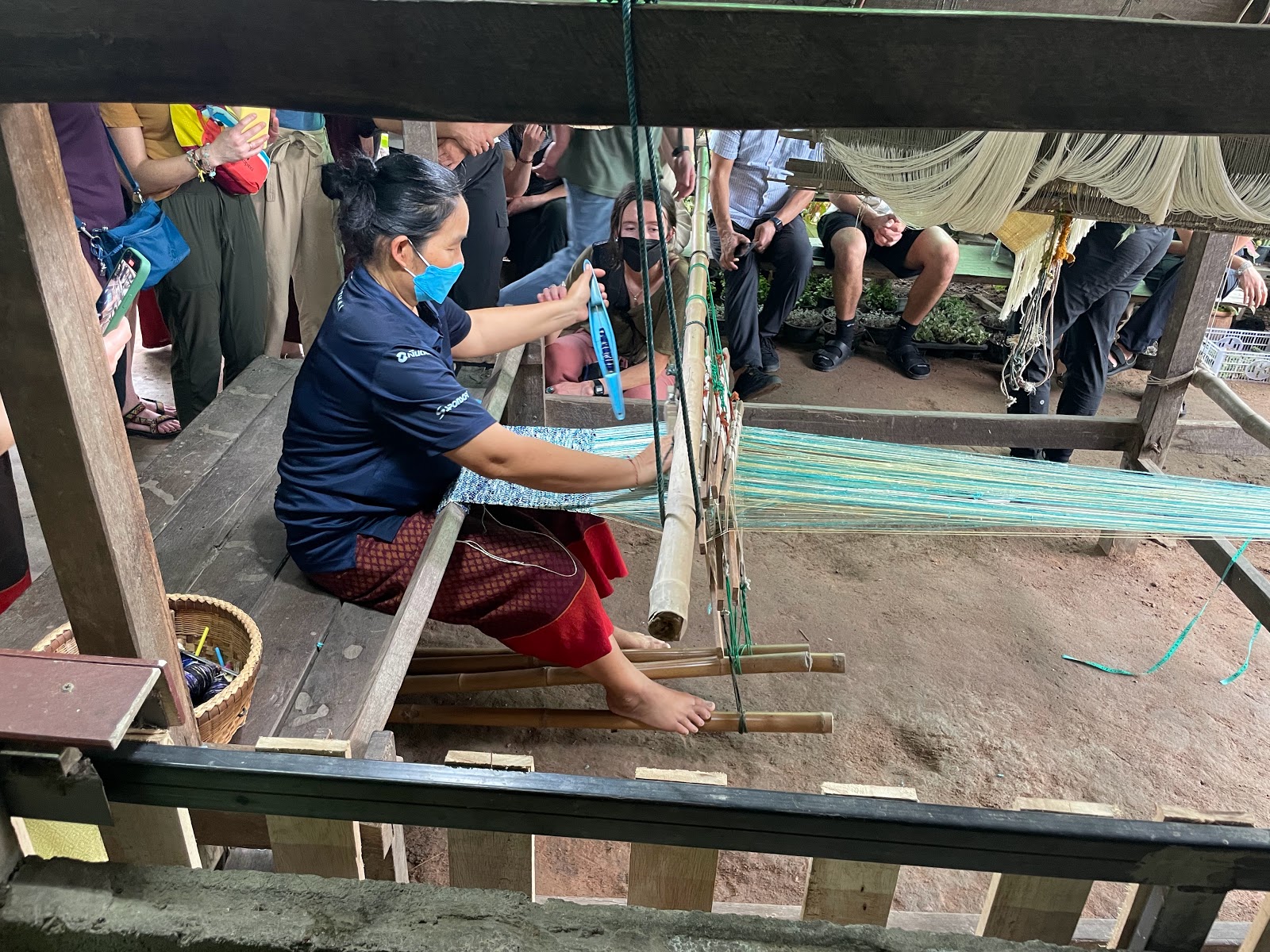
The last stop was the Nong Takai Ancient Silk Product Center. This was a fascinating look into the experience of harvesting and weaving silk. We got to see every step of the process:
  • feeding the silkworms
  • boiling their cocoons to extract the silk
  • boiling the raw silk to soften it
  • dying the silk
  • and lastly, the weaving process
Feeding the silk worms

Boiling the cocoons to extract the silk

One technique used to weave the silk

The amount of energy and time it takes to produce a scarf or a skirt is pretty remarkable. And the folks involved in the silk extracting and weaving process are so incredibly talented and efficient. Also, we ate some silk worms.

MTSE faculty eating silkworms

Okay, that’s probably enough for now. I need to discuss a plan of attack with the geckos.

Wednesday, May 11, 2022

Thailand Days 1 - 3: Bangkok and Buriram Province

May Term Thailand XII
[dusts off cobwebs from blog]

Hard to believe the last time I updated this blog was 2019, about 4 months before the World Health Organization declared COVID-19 a global pandemic. I was slated to participate in the May Term Study Experience (MTSE) Thailand in 2020, but it was cancelled for obvious reasons, as was the 2021 trip.

Fast forward 2 years, and here we are. Before getting too far into the play-by-play of the trip thus far, I want to acknowledge and dedicate this post to my good friend Peter. He and Han are the reasons I’ve been afforded this opportunity, and the Westminster May Term Thailand program would not be the incredibly well-established and successful program that it is without Pete and Han’s partnership for over a decade. Pete, I am grateful for our friendship and please know how much you are missed on this trip.

Okay, here we go.

Thailand Day 1…well…kind of. (Travel Day)

Kathryn and Reese picked me up at 5:00 AM to meet the rest of our crew of 29 (3 faculty, 26 students) at the SLC airport. Reese, thank you for giving us a lift at such an ungodly hour. It was good that we did get to the airport so early because there were a handful of things that didn’t go according to plan.

As we say in Outdoor Education and Leadership (OEL), “planning is essential; plans are worthless.” The challenges were as follows:

  • Due to limited flight options and COVID restrictions, the travel agent that booked our group flights ended up splitting our group between different airlines/itineraries. Our travel agent accidentally divided the group in such a way that I had the challenge of shepherding 23 students from SLC LAX Tokyo solo as it was too expensive to alter our group’s reservations. Luckily, we have a stellar, responsible group of student travelers, so this challenge was really a non-issue. And I got really good at counting to 23.
  • The other group, led by Han and Kathryn, had a more significant road bump. Upon trying to check-in, they were informed by Delta that they couldn’t check-in without producing negative COVID tests to travel through Tokyo Narita, despite Japan Airlines (the second leg) being very clear with the group that we didn’t need to produce negative tests as we were not actually leaving the Narita airport. After about 30 minutes of increasing panic coupled with politely haggling with the ticket counter staff, the manager eventually confirmed that we did not, in fact, have to test, so they eventually got checked in and merrily went about their way.
  • Two students (one in my group, the other in Kathryn/Han’s) had their flights canceled from their hometown back to SLC the night before our departure, so they had to get rerouted to meet us at LAX and SFO.
  • Once these issues were resolved, it was mostly smooth sailing getting into Bangkok. A few minor hiccups that I would put in the realm of “issues that happen on almost every study abroad experience,” and a very, very long travel day of 30+ hours, but we all made it to our final destination safely and in pretty darn good spirits.
May Term Thailand XII faculty: Han (Public Heath), Kathryn (History), Kellie (Outdoor Education and Leadership)

Upon arriving in Bangkok at about 1AM local time, we boarded vans and set out for the Holiday Inn Sukhumvit, located in what I would consider a shopping district of Bangkok. We checked in and all immediately went to bed as most of us hadn’t logged much sleep over the last 30 hours (for some of our students who graduated on Saturday, their sleep debt was even worse!).

Group photo in the Bangkok Airport

Day 2 – Bangkok

After some much needed sleep and showers, we started our first “official” morning off with breakfast and a mini-tour of the area, hosted by Han. We checked out a local park (which included a cool Zero Waste exhibit) and one of the local malls.

Han providing context for the area around our Bangkok hotel

Around lunch time, we met up with Noi, Rose, and Michel, our *amazing* primary local hosts for the month-long experience. As a group, we walked over to the mall to take care of tasky things—namely, getting SIM cards for phones, getting baht (official Thai currency) and eating lunch.

After errands were completed, the group had a few hours of free-time before meeting up to walk to a different shopping district to make sure that we all had appropriate clothing for temple and village visits, followed by a lovely family-style dinner at the Cabbages and Condoms restaurant in downtown Bangkok. Yes, you read that correctly. Cabbages and Condoms is part of a larger unit of resorts, restaurants, and initiatives designed to help the Thai population minimize risk of HIV/AIDS transmission and improve family planning resources. It’s been incredibly successful. From their website (edited slightly for clarity):

“C&C operates restaurants, resorts, community-based ecotourism and training centers, and uses the earned income to support the development of quality of life and community. C&C is part of the Krabi Integrated Rural Development Center (BIRD-Krabi), a unit of the Population and Community Development Association (PDA).”

Sadly, I did not take any pictures of our food, but take my word for it—it was really, really good.

Group Dinner at Cabbages & Condoms, Bangkok

Day 3 – Phanom Rung Historical Park / Nang Rong District, Buri Ram

A group of students/faculty met at 6AM (!!) to get a quick run in before departing on a 4-ish hour drive en route to Phanom Rung historical park, located in the Phra Kiat District (Buri Ram). Phanom Rung is a Hindu Khmer Empire Temple complex set on the rim of an extinct volcano at 1,319 ft elevation (Wikipedia). The temple is dedicated to Shiva and was built between the 10th and 13th centuries.

Image of temple stonework (Phanom Rung)

Image of temple grounds (Phanom Rung)

Sculpture at Phanom Rung

MSTE Faculty at Phanom Rung

Group shot of students at Phanom Rung Historical Park

I’d like to say more about the temple, both architecturally and historically, but I am fading fast so I’m going to speed this up.

After visiting Phanom Rung, we drove about half an hour to the Cabbages and Condoms resort in the Nang Rong district. While not as modern or bougie as our Bangkok lodging, this rustic resort is quiet and colorful. It rained pretty heavily during dinner, and while sitting under our covered outdoor seating eating delicious green curry and watching water droplets hit the surface of the pond, I felt very content.

 View from our dinner spot

Our last activity for the evening was a presentation by Han and a representative of the Population and Community Development Association (PDA) explain the legacy and impact of the founder of Cabbages and Condoms, Mechai Viravaidya, “a safe-sex activist and founder of Thailand's Population and Community Development Association (PDA), established the eatery with the philosophy that birth control should be as accessible and mundane as cabbages” (Slate).

Presentation on Population and Community Development Association

We’ll get to see more of Mechai’s work in action tomorrow.

With that, I’m officially caught up with our itinerary. More to follow.

Greece (9/16 – 9/26/2021)

Update!! (7/29/22)

Nearly a year after the trip (...), I found the notebook in which I wrote my notes for Greece! Here we go!

Greece: Days 1 - 3 (9/16-9/18/21)

I'm excited to resurrect my travel blog after a two-year hiatus so that my 1 reader (hi, Mom!)* can get a sense of what we're up to in Greece. I'm pretty sure I make that joke every two years.**

*Wow, I think I've made this joke at least 5 times over the course of this blog... **OMG! I actually called myself out about making the joke while making the joke. This blog is starting to feel very inception-y...

Background: Our friends, Lisa and Jon, got married in May and booked a private catamaran to sail the Greek Isles as a slightly delayed honeymoon. The boat had a few extra cabins, so KJ/I and our friends Ashley and Mel were the two lucky couples to score an invite. KJ and I haven't taken a "real" (read: non-St. George, Utah) since we started dating ~2.5 years ago, and it's been a long (and ongoing) pandemic, so we figured this was a once-in-a-lifetime opportunity to sail the Greek Isles with good friends and **not have to plan it ourselves**. Also, shout out to our pals at Beehive Sports for connecting us to folks that are now lifelong friends.

Day 1: 5:30AM wake-up --> SLC --> ORD --> ATH: Acropolis, Stadium, National Gardens, Lycabettus Hill

A long travel day but relatively smooth. KJ taught me backgammon on the plane* and it's become a highlight of the trip. We arrived in Athens around 7AM local time and caught a taxi to Platia Sintagmatos to meet the rest of the crew at a delightful AirB&B in the heart of downtown within walking distance to many major historical sites. We grabbed some street giros and set out for the Acropolis.

*I still play backgammon on my phone for about 5 minutes EVERY DAY!

From History.com:
"The Acropolis of Athens is one of the most famous ancient archaeological sites in the world. Located on a limestone hill high above Athens, Greece, the Acropolis has been inhabited since prehistoric times. Over the centuries, the Acropolis was many things: a home to kings, a citadel, a mythical home of the gods, a religious center and a tourist attraction."

Touring the Acropolis involves a fair amount of walking/climbing steps, and it was a hot and humid day, so while conditions weren't ideal, it was worth the ensuing sweatiness. After the Acropolis, we popped over for a quick view of the stadium and National Gardens.

View of columns at the Acropolis

The group touring the Acropolis

View of Athens from the Acropolis

Kjarsten, Mel, Ashley, and Jon at the National Gardens

At this point in the day, KJ and I had been up for 24+ hours. No sleeping on the plane for us and we decide to power through the day in order to set our internal clocks to Greece time. We grabbed a few drinks and snacks at a cafe before KJ tapped out and the rest of us set off on foot for Lycabettus Hill, which promised a dinner location with stunning views of the whole city. 2km walk from our AirBnB with 600 feet of elevation gain in the last half mile of the walk. Yeah, I'm mixing measurement systems in this description--sue me. I was pretty delirious by this point due to lack of sleep, but the walk and delirium were worth the view.

I'm probably drinking Ouzo.

View of the city at night from the restaurant on Lycabettus Hill

Day 2: Getting on the boat / Aegina

KJ and I popped out of bed around 7AM feeling like fairly-well-adjusted human beings. He went on a short walk around the neighborhood to track down some Greek coffee and pastries. We took a few hours to pack up the AirBnB before heading to the Alimos marina to board our yacht. Some technical malfunctions delayed our boarding by about 3 hours, so we passed the time at the marina cafe over drinks and beef kabobs. Could have been worse.

Around 5PM, we met our captain, Emilios, and set out for our first spot to weigh anchor for the night at cove on the island of Aegina, the closest island to the mainland. After our safety briefing, we dropped anchor, swam and paddled for an hour, and cobbled together dinner on the board (hard to go wrong with feta, olives, and salami, IMO), established a tentative sailing plan for the week based on water and wind conditions, and settled in for the night.

Home, Sweet Yacht

We are happy to be on a yacht

Intense game of backgammon

Weighing anchor off of Aegina